3D TRACK FORECAST
Johns Hopkins University · Brains, Bots, and Behavior Lab
MotionForesight
Re-purposing Video Models for Future 3D Scene-Flow Prediction
Abstract
Predict the motion that matters.
Humans can infer how objects are likely to move from passive observation: a cup may be lifted, a drawer may slide, and a lid may rotate shut. Such predictions expose the physical consequences of interaction needed to act in the real world. We study how to learn this anticipation from ordinary monocular videos of human-object interaction. Given a short observed video context, MotionForesight predicts future 3D trajectories for points on the manipulated object. This casts interaction prediction as object-centered 3D motion forecasting for any object including those that are rigid, articulated, or deformable.
Our key insight is that video prediction models already encode rich priors about how objects move during human interactions. We redirect these priors from pixel prediction toward future 3D scene flow. We start from a dense 3D tracker built on a pretrained video model, generate pseudo-ground-truth tracks from complete clips, and train the forecaster using only the observed frames. We replace future RGB and geometry with learned mask latents and train a lightweight adapter to turn the retrospective tracking representation into a forward predictor, while freezing the large video and tracking components. Using just 40k human videos and no auxiliary inputs such as language, MotionForesight generalizes across diverse out-of-distribution objects, environments, viewpoints, and interactions. It also outperforms substantially larger models that use over a million training videos.
Overview
Learn motion from complete videos, then forecast beyond the observed context.
During training, complete interaction clips provide object masks and pseudo-ground-truth 3D tracks extracted from monocular videos, as supervision. At inference time, the forecasting model receives only a short observed context and predicts the object’s future 3D motion.
Method
Turn tracking into forecasting.
MotionForesight preserves TrackCraft3R’s point-track interface, but hides every future observation. The model must infer how reference-frame object points continue to move based on the short observed context.
Data curation
Human video, lifted into 3D.
Something-Something-V2 interaction clips are processed offline to recover object masks, metric geometry, camera motion, and dense 3D tracks. Future frames supervise the target—but are not input to the forecasting model.
- 40K
- training videos
- 7 → 22
- observed → future frames
- 320×576
- model resolution
- 01Find the objectlanguage-guided mask extraction and propagation
- 02Recover geometrymonocular depth, camera motion, aligned pointmaps
- 03Track complete clipsdense reference-anchored 3D trajectories
- 04Hide the futuretrain only from observed RGB and geometry
Qualitative results
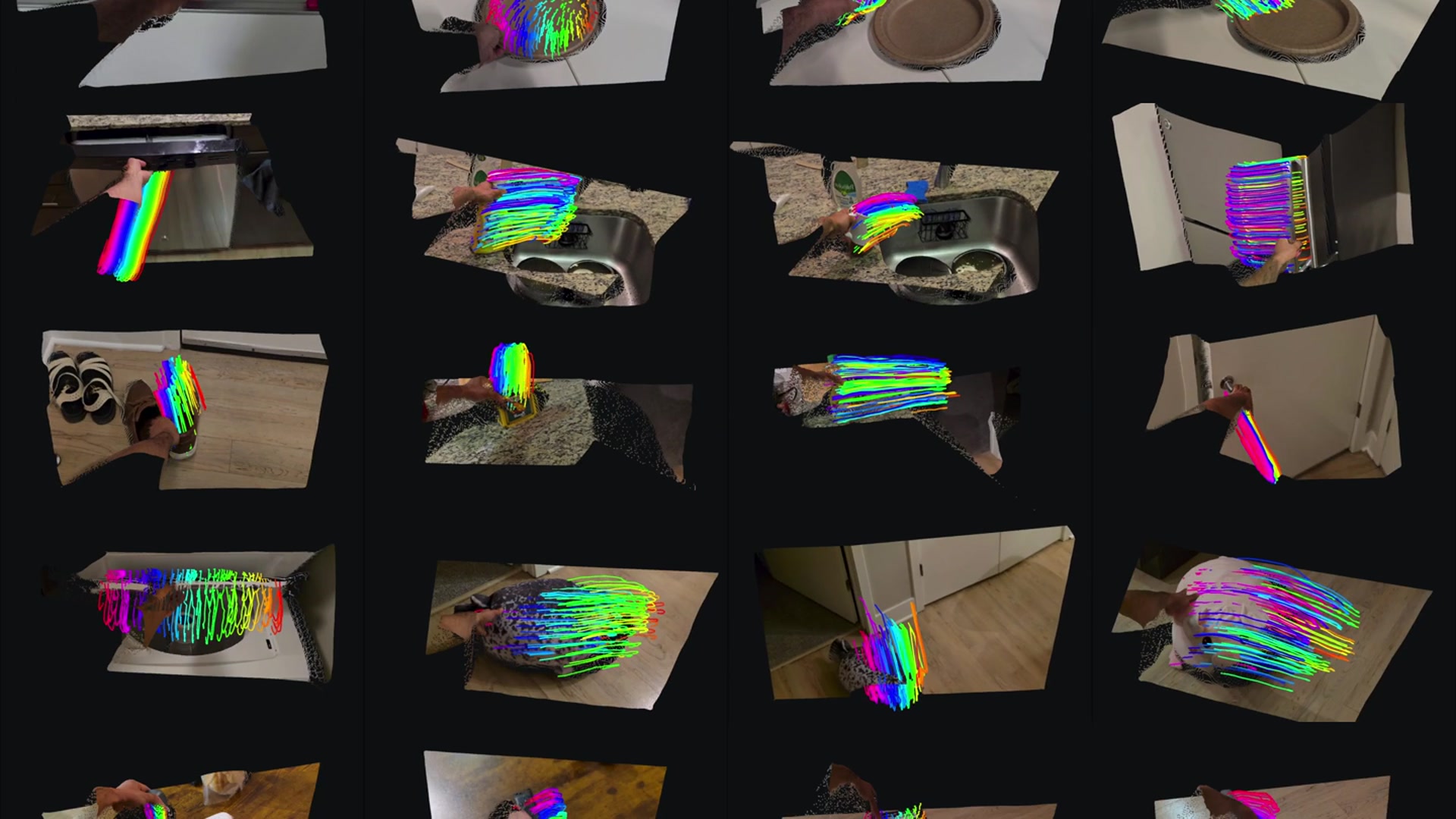
One interface, many kinds of motion.
Across everyday objects and articulated scenes, MotionForesight predicts spatially coherent future point motion from only the observed video context.
3D TRACK FORECAST
3D TRACK FORECAST
3D TRACK FORECAST
3D TRACK FORECAST
3D TRACK FORECAST
3D TRACK FORECAST
3D TRACK FORECAST
3D TRACK FORECAST
3D TRACK FORECAST
3D TRACK FORECAST
3D TRACK FORECAST
3D TRACK FORECAST
3D TRACK FORECAST
3D TRACK FORECAST
3D TRACK FORECAST
3D TRACK FORECAST
3D TRACK FORECAST
3D TRACK FORECAST
3D TRACK FORECAST
3D TRACK FORECAST
3D TRACK FORECAST
3D TRACK FORECAST
3D TRACK FORECAST
3D TRACK FORECAST
3D TRACK FORECAST
3D TRACK FORECAST
3D TRACK FORECAST
3D TRACK FORECAST
3D TRACK FORECAST
3D TRACK FORECAST
3D TRACK FORECAST
3D TRACK FORECAST
3D TRACK FORECAST
3D TRACK FORECAST
3D TRACK FORECAST
We compare MotionForesight with MolmoMotion and video-generation baselines in our side-by-side baseline video gallery .
Citation
@article{bharadhwaj2026motionforesight,
  title={MotionForesight: Re-purposing Video Models for Future 3D Scene-Flow Prediction},
  author={Homanga Bharadhwaj and Yash Jangir},
  year={2026}
}